BBU and BAF at War
Planned events in March 1979 brought things to a head between the two organizations.
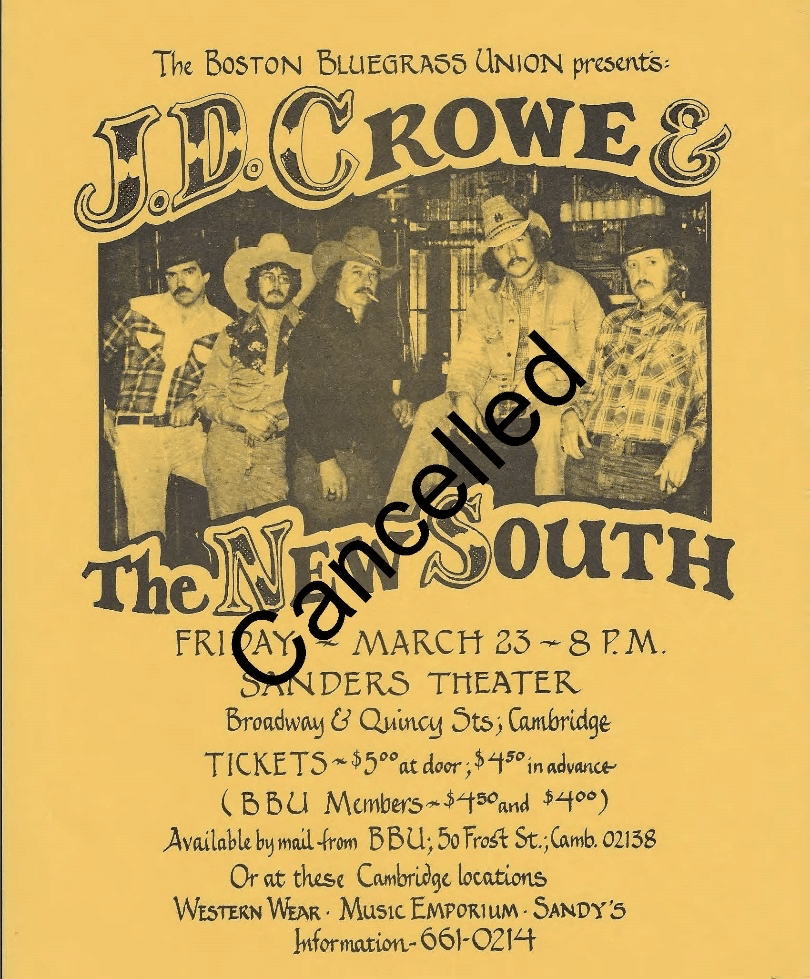
“Feud turns Boston bluegrass to purple,” headlined a Steve Morse Boston Globe column in March 1979.39 BBU had been formed, he wrote, “by disaffected BAF members who said they could no longer work with BAF director Nancy Talbott.” Over the first couple of years, he said, the two organizations “had appeared to be easing toward peaceful coexistence.” But then things exploded. The BBU booked J.D. Crowe and the New South into Sanders for a March 21 show and BAF booked the Osborne Brothers into the Berklee Performance Center on the very same evening. Crowe then canceled the BBU date and became the opener for the Osbornes. BBU president Stan Zdonik said that Crowe called him and said that Nancy had said she “wouldn’t book him at her festival if he went ahead.”40 Nancy said that BBU had a “personal vendetta” against her and “If they want to book major concerts, they’re going to have a fight on their hands.” She added, “Originally BBU claimed to be interested in New England bluegrass musicians. That’s no problem for me, but when they start messing with the Southern stuff, that bothers me.” She had acknowledged the hold the music had on her: “Bluegrass is a disease. I’m afflicted with it. It’s something in the blood, although there’s no money in it, no glamour.”41
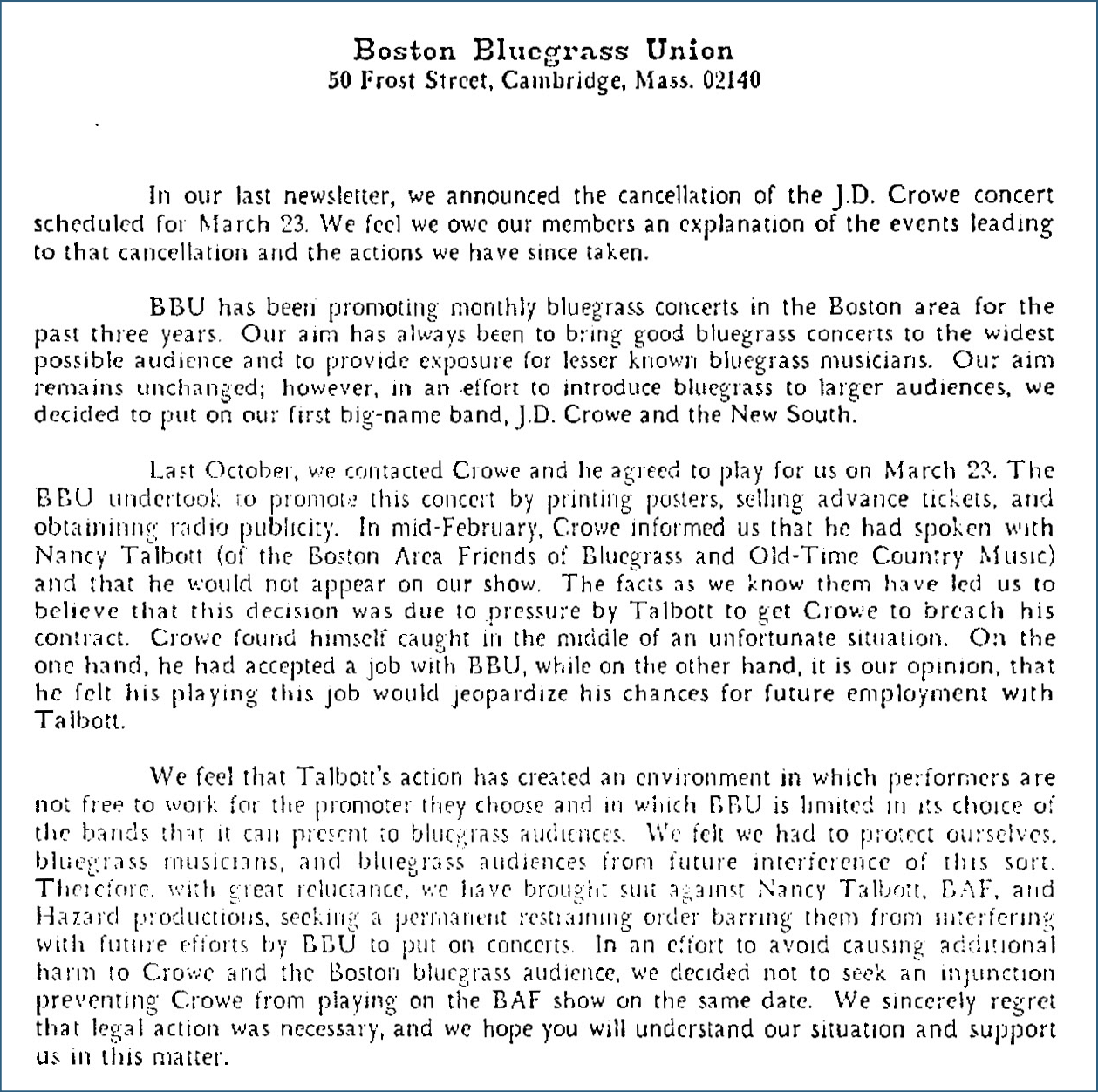
There was no shortage of hard feelings. Nancy lashed out at Rounder Records, saying the company was “behind BBU and has made several statements about taking over bluegrass in New England” and that Rounder was pressuring Crowe – who recorded for Rounder – into going with the BBU show. Ken Irwin of Rounder was quoted saying that was “totally untrue.” Reached by phone, Crowe denied pressure from either side but that the agreement with BBU had been verbal, rested on their finding other gigs in the region, and “they were a little pushy in going ahead and printing up tickets.” Pushy, or perhaps inexperienced. Crowe was “flustered” by the controversy and said he didn’t want to hear about when he got to Boston “and said he might punch the first person who mentions it.”42
Stan Zdonik said that BBU members were “demoralized” and that “if Talbott can do this for this show, then she can do it again.”42
The concert went off – for BAF – as an artistic success, but it was noted that BBU had filed a lawsuit against BAF “seeking financial reparations.”44
It doesn’t appear that the purported lawsuit really went anywhere. Money may have been a problem, as it often is, but it does not appear that Nancy was siphoning away money for herself. To the contrary, a number of people suggest that her biggest financial problem was that she was overly generous with the musicians, borrowing money to pay them and not always able to pay back the people from whom she borrowed.
Her sister Bar described Nancy: “No business sense. No idea with how to deal with…She was a horrible businessperson. She gave all of her money to the musicians. She didn’t create anything for herself.”
Nancy’s personality was a problem as well. Sooner or later, it seemed, everyone with whom she worked in the bluegrass realm had a falling out, for one reason or another. David Hershey-Webb may have been spared some of that, by virtue of being a young teenager when he worked on BAF and the early festivals. “For me, there was never a…she loved me to death. I guess I wasn’t a threat. I felt like she gave me incredible opportunities. I adored her. Until later. She was a visionary. Her love for the music was incredible. I just decided to go on to other things. I had no falling out at all. Definitely not.” His mother Susan Hershey, though, had a “so-so” relationship. “That was different. They fell out when Nancy came to her house in Rockport and refused to not smoke in the house. My mother said, ‘Could you not smoke in the house?’ And Nancy got pissed off.” David added, “I liked the Boston Bluegrass Union people. Nancy was a prima donna. She was something mad, but she accomplished a lot. She did great things. Very dedicated.”
Footnotes –
- Steve Morse, “Feud turns Boston bluegrass to purple,” Boston Globe, March 8, 1979: 732.
- Morse, “Feud turns Boston bluegrass to purple.” Stan Zdonik reaffirmed this in an interview on March 12, 2025.
- Steve Morse, “Boston Bluegrass – Southern mountain music strikes a chord in rock-conscious Hub.”
- Morse, “Feud turns Boston bluegrass to purple.”
- Morse, “Feud turns Boston bluegrass to purple.”
- Steve Morse, “The Osbornes at Berklee,” Boston Globe, March 26, 1979: 27.