Why BBU? Discontent in the Boston Bluegrass Scene
Why had the Boston Bluegrass Union formed in the first place? It may have been that Nancy Talbott simply wanted to run things her own way, and only her way. Fred had left the area. She was possessed with the aforementioned “messianic zeal.” Perhaps she just didn’t work as well with others, except as assistants, and there was an increasing number of other folks who wanted to become more involved with the burgeoning bluegrass scene.Many music promoters, of course, are individualists and no one is surprised by that. The difference was that Boston Area Friends purported to be more of a community and there grew a perceived gap between that idea and actual practice.
There was also a sense that Nancy was increasingly favoring musicians from outside the region.
For a couple of years, the two organizations worked side-by-side, often both using the same church hall for concerts. There were tensions, as one might expect, and several who had worked with BAF moved over to BBU.
Richie Brown said, “I thought what Nancy was doing was admirable but making accessible to people is what bluegrass is all about. We wanted to draw people in. Doug Tuchman in New York was able to play two or three grand for bands, but we weren’t. We weren’t really into doing big show productions.” There was more of a community spirit to the effort. “A lot of people wanted their bands to play. We wanted to have children involved – the way Tony Watt is doing now.”
Stan says he’s pretty sure the name for the new organization came from Joe Val, who was playing every other Tuesday evening at Passim in Harvard Square and was active in the discussions. Joe’s first suggestion was Beantown Bluegrass. The group settled on Boston Bluegrass Union.
In March 1978, mention of discord between the two groups appeared in print, in a full-page Boston Globe article on the Boston bluegrass scene. It noted that in 1976 “certain followers of the BAF became disgruntled with what they say was Talbott’s tight control, and so splintered off” to form the Boston Bluegrass Union. Nancy accused BBU of stealing her mailing list while they accused her of “headstrong, occasionally abrasive leadership.”32
No, Nancy wasn’t entirely being paranoid about the mailing list. The two groups were not meshing smoothly. Her sister Bar explained in her 2025 interview: “I know what happened. The Boston Bluegrass Union hadn’t formed, but they were forming. They wanted to put on shows. They didn’t want to compete with Nancy. But she wasn’t being nice to them. They seemed nice to me. I thought she was being obstinate. I don’t know how you will say this,” she said, “I really feel awful…anything with family…I just…though at the time I didn’t feel badly…I essentially gave them Nancy’s mailing list. She wouldn’t share that information.”
Bar continued, “They came to her concerts. They were very much involved in bluegrass and really loved it and supported her. From my vantage point – of not having built the organization – I had typed all the labels – it just seemed that…. You knew Nancy, and she could be Nancy – and I was being a reactive, opinionated, and not very loyal sister. I feel badly about it. I don’t know. She wouldn’t listen. You couldn’t get her to listen. And whatever the thinking was…I certainly tried to convince her…we all did. But she was insistent…and that’s what I did.”33
Stan said that Bar was “a member of the so-called board, and a nice person. It was only after a while that we figured out she was Nancy’s sister. Bar Perryclear.” She was indeed named Bar Loritz at the time and had signed the very first BBU news announcement as such. Stan regretted the controversy. As things had developed, “Nancy was only doing shows at the level of the Osborne Brothers and we thought there was room for another organization that could do shows that were more in the middle. That part of the history is interesting, but I would rather forget about it. It was not at all positive.”
In retrospect, Bar also has regrets. She prefers to focus on Nancy’s “energy and spirit and love of bluegrass music. It is painful to have so much focus on the details of who did what when, particularly as I feel I betrayed her. I like to think the person I am now would have behaved differently. Nancy was such a comfort for me when I was growing up and I think contributed the support I needed at times. I know she brought joy and unity that gave us a way to connect.” 34
Staying neutral, as one would expect, was Hillbilly at Harvard. “Sinc and I were essentially spectators [to the “bluegrass wars],” recalls Lynn Joiner. “Nancy used to come in and we’d plug her things. And then BBU people used to come in and we’d plug their things. We were not trying to take sides. If you put on good music, we’d be happy to plug it.” Neither radio host worked with either organization. “Basically spectators.” 35
Had BBU stuck with smaller Sunday shows at the “church with the big brown rooster on top” while BAF promoted larger shows and the summer festival, there might have been a modicum of peace. But it was not to be.
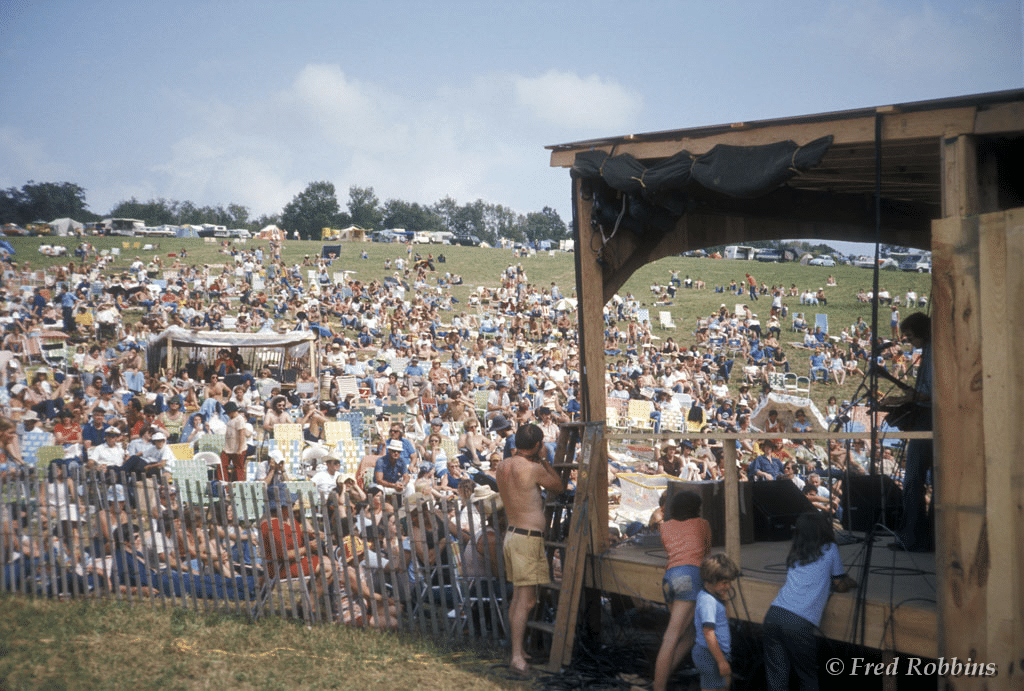
The third annual Berkshire Mountains Festival – a Nancy Talbott production – was held in the summer of 1978 and 1979 in Ancramdale, New York on the Rothvoss family farm. Following a financial dispute with the Rothvoss family, there was no festival held in 1980.36 An unverified story had one of the family pointing a gun at Nancy and threatening to break the teeth she had recently repaired at great cost.37 The festival had other locations in 1982, skipped 1983, and then was held in 1984 and 1985 after which time Nancy left the festival business. It was revived as Winterhawk, with Mary Doub as an early backer. Later the festival was renamed as Grey Fox, and continues to this day in Oak Hill, NY.38
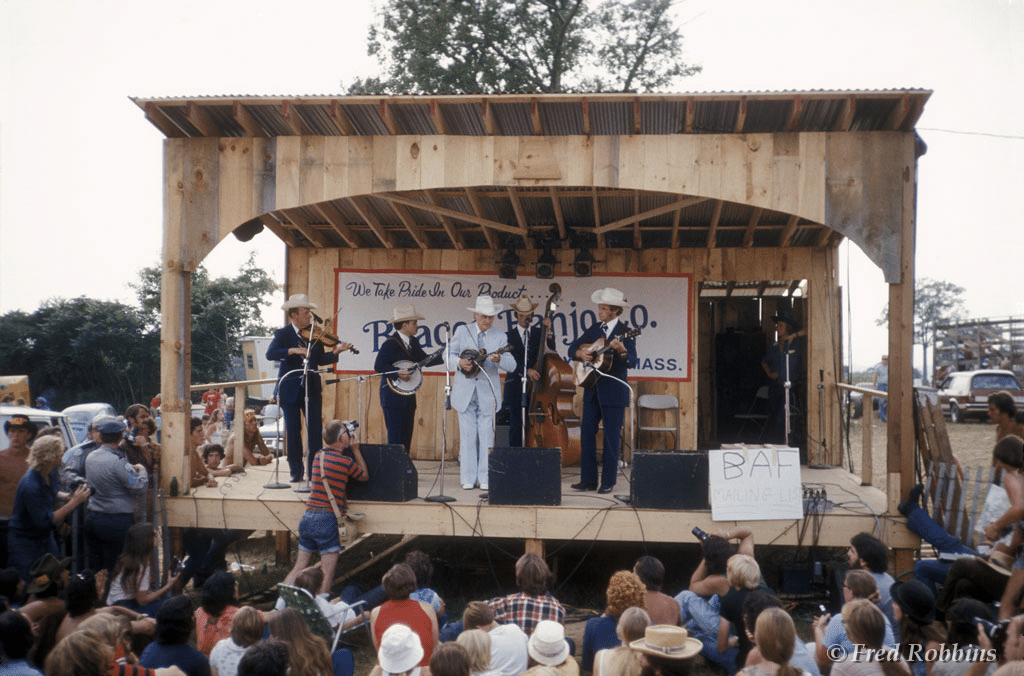
The Seldom Scene played Sanders for BAF in January 1979.
Country Gazette played a BBU show at the church on February 11.
Footnotes –
- Morse, “Boston Bluegrass – Southern mountain music strikes a chord in rock-conscious Hub.”
- Interview with Barbara Perryclear.
- Email from Barbara Perryclear on October 15, 2025.
- Interview with Lynn Joiner on October 12, 2025.
- Calvin Knickerbocker, “Ancramdale – the Cradle of Northern Bluegrass.”
- Fred Bartenstein recalled hearing the story about Nancy’s teeth. Email to author on December 12, 2025.
- An article about Mary Doub from 2015 can be found at: https://hvbluegrass.org/mary-doub-producer-of-grey-fox-bluegrass-festival/