Additional BBU Board Members
Another early participant was Eric Levenson, who played bass with Joe Val and the New England Bluegrass Boys at the very first Boston Bluegrass Union show. He had come from Oceanside, Long Island in 1959 to study architecture at Harvard. But he detoured into theatre and took a year off to work at the MIT Theatre and soon became set designer at the Loeb Experimental Theatre. He was in a group living situation in Brighton along with Steve Watt, who first introduced him to Hillbilly at Harvard. Steve played mandolin and banjo and one of the others played guitar. They decided that the housemates should start a “house band” and went to a hardware store. Steve was a cabinet maker. They made Eric a washtub bass. “By Christmas time, they bought me a real bass.”45
Eric graduated from Harvard in 1963, had his son Alec in 1966, and became a member of the New England Bluegrass Boys in 1975. Joe Diviney had replaced Bob Tidwell on bass, but Joe Diviney had work that would sometimes take him off to, say, Saudi Arabia for a few weeks at a time. Paul Silvius joined the band and brought Eric over. By 1976, Eric was handling bookings for the band, too. Previously, Bob Donlin of Passim had been “manager” of the NEBB (Eric put that in air quotes, because Bob was thinking more local, had other fish to fry, and wasn’t looking to book concerts further from the local area.)
Eric volunteered some with Boston Area Friends, but as BBU began he promptly transitioned over. “It was a whole different thing” – truly collaborative. He added, “Joe [Val], who was never politically correct about certain things, would call Nancy the ‘Dragon Lady.’ She was a little hard to get along with at times. There was a group of people who really thought these regular concerts were great, but who grew tired of being Nancy’s handmaidens, with a lot of friction and not being overly appreciated and not wanting to work that way.” He singled out Stan Zdonik as key to BBU’s success: “What made BBU work…Stan was a major, major, major player.”
Eric’s son Alec got involved early on, too. He worked with Florence “Fluffy” Bergmann in food prep at the BBU shows. “At the church, Alec was totally into a project like making a 50-cup pot of coffee.” With the New England Bluegrass Boys, he used to travel with the band and sell merchandise. Somerville-born Fluffy didn’t really become active until around 1986 or 1987 but ran the refreshment table for a number of years and came to earn the title of the “Queen of Hospitality.”46
Steve Watt’s father played the mandolin even before he did – folk music, Jewish folk songs, and more. Growing up in New York City, Steve was in the Bronx in high school and graduated from the University of Wisconsin in 1965. He came to Boston in 1967 after his brother helped him get a job at MIT in X-ray astronomy – “basically computer programming and data analysis.”47 He’d seen Flatt & Scruggs back in 1957 at a wrestling arena in Queens – Sunnyside Gardens. In high school days, he frequented Izzy Young’s Folklore Center in the Village and was at Washington Square most Sundays where he saw Roger Sprung, Winnie Winston, Andy Statman, Artie Traum, and many others. After coming to Boston, he remembers picking on the Cambridge Common. He does take credit for helping get that washtub bass for housemate Eric Levenson. “That became the nucleus of my first band there – Lightning Express. It was Andy, Eric, me, and Alex Tottle – Jack’s ex-wife and quite a good fiddler.”
Steve also did sound for the earliest BBU shows. “I ran sound for the shows at the church, If you have any tapes, they’re from my soundboard. No professional. It’s just what we have at the time, the PA, for our band to use, and I just used it from the BBU.”
Steve does recall that BBU tried to honor the 50th anniversary of Boston Area Friends and reached out to Nancy Talbott. “I guess they wanted to present her an honor or something and she wasn’t amenable. Stan just called her up and she said, ‘F— you.’ I used to see her from time to time, and chat, but I wasn’t into crop circles….” (The reference to crop circles was to a later obsession of Nancy’s.)
Steve’s son Tony Watt grew up with bluegrass and as the Boston Bluegrass Union enters its 50th year has become president of the board. He first joined the board in the year 2011.
Richie Brown mentioned earlier that the idea to form a new organization may have formed during some informal get-togethers at Ray Magliozzi’s house in Arlington. Ray and his brother Tom later became well-known nationally as co-hosts “Click and Clack” on the NPR weekly radio show, Car Talk, which debuted in 1987. Both were Cambridge natives and MIT graduates. Car Talk was an immensely popular program, and Tom and Ray used “Dawggy Mountain Breakdown” by David Grisman as a theme song, exposing bluegrass to a much wider audience.48
Ray graduated from Arlington High School in 1966 where he was a classmate of Susan Bartholomew. Stan Zdonik had graduated the year before. Ray had initially played folk. Tom Paxton was an early favorite, but it was seeing Doc Watson that really changed everything, and inspired him. Living in Vermont in the early 1970s, his brother Tom called Ray at one point and said, “Hey, next time you come to Boston, Stan and I found this guy playing at Passim, a guy named Joe Val. You’ve got to come listen to these guys. They play on Tuesday nights.” In the mid-1970s, Ray welcomed Joe Val to his house on the occasional Friday night when Joe wasn’t playing a gig. The two brothers, Stan Zdonik, and Ron Faccenda “started our own little bluegrass group. None of us knew much about it. I had played guitar for a while. Joe and Richie would help us with some of the instrumentation and some of the vocal stuff. Joe was always a joy to have around.”49
They formed a band – the Mystic Valley Boys – with Stan on mandolin, Tom Magliozzi on bass, Ron Faccenda on banjo, and Ray on guitar.50
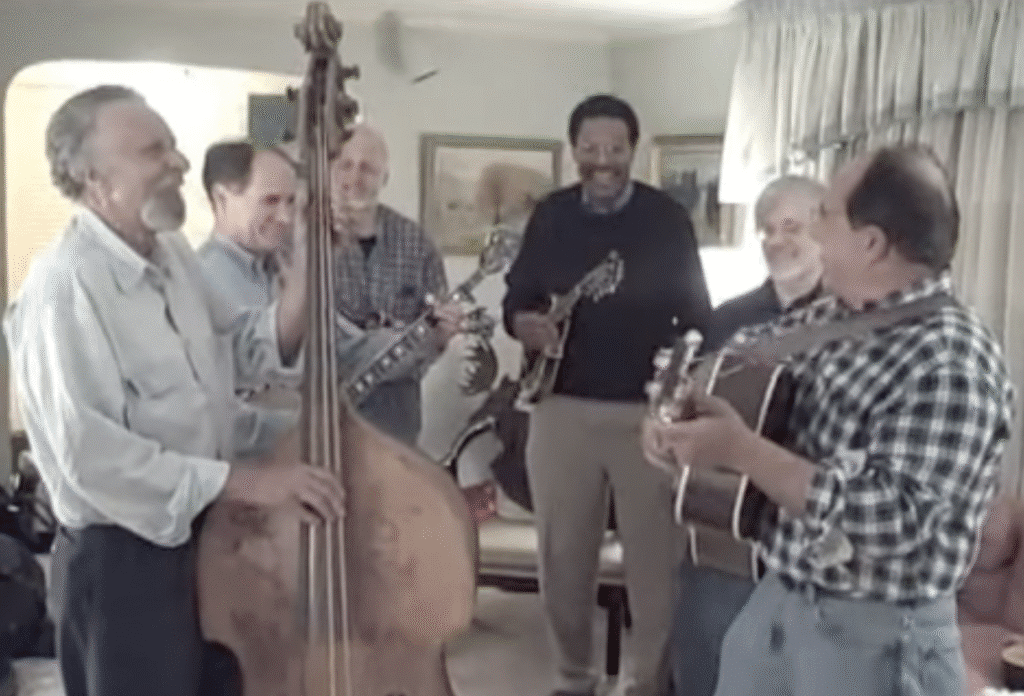
Ray had gone to Boston Area Friends shows and met Steve Watt there. Ray then became involved with the new organization. He says, “I remember those early BBU meetings when Stan and Richie and some of the others were involved – with Stan’s first wife – trying to wrest control from Nancy Talbott. We knew first-hand from performers like Joe and others that she was kind of tight with the money. We felt that was unfair to the musicians.”
In discussions regarding Nancy and finances while preparing this history of the founding of BBU, many cited money as an element in the equation. It’s impossible to pin down 50 years later, but the impression one gets is that Nancy wasn’t trying to salt money away for herself, and in fact had a reputation for overpaying some bands from the South, but perhaps at the expense of local performers. As Ray put it, “I don’t know anything about her personal finances, or the way she managed her books. The consensus was that she wasn’t paying the local performers that I knew – she wasn’t paying them very well. She was not an easy person to deal with. I think that was the motivation, and also to help promote bluegrass music in this area in a healthier way, so to speak.”51
There was more than one reason for the parting of the ways. Dan Marcus, the high-school friend of Richie Brown who also had a relationship with Nancy Talbott for a while, told Taylor Armerding in 1980 that the split began, at least in part, because “Nancy started to want to move on to bigger things. It was difficult for her to let other people take a responsibility and do their job…she had to do everything.”52 Taylor cited Richie at the time as saying that Nancy became “tyrannical” and was also refusing to book local bands for the BAF concerts. Richie said, “We wanted to help out some of the groups she wouldn’t do anything with, and besides that, people were getting pissed off over phone bills and the financial records.”53 Her concerts were drawing from 700 to 1000, while BBU’s more popular shows would attract 200-300. The larger shows lacked the informality and some of the community spirit that BBU began to offer.
There was some learning involved. Dan Marcus said, ““The great difference between BAF and BBU is leadership. Nancy has a vision…she looks at it almost as a mission” while admitting “Sure, it’s an ego trip for her” but noting that BBU shows weren’t offering pickin’ parties after shows at the time, adding, “That lack is a terrible thing … one of the greatest appeals of the music is gone.” Richie Brown told him that they were bringing it back at the BBU shows, but acknowledged it hadn’t been happening for a while.54
Ray Magliozzi joined BBU and said he was the treasurer at one point. “I kept all the money in a cigar box. A very low-key operation. Those meetings were always pretty good. There was no animosity or ill will. Everyone who was there just wanted to see bluegrass music get a larger audience. We loved it so much. We made sure that more people could listen to it and enjoy it the way we did.”
He remembered going to Steve Watt’s place, to pick up amplifiers for the sound system before every show.
Ray spoke highly of what the Boston Bluegrass Union became – a true community organization. He noted Gerry Katz and – more recently – Tony Watt in that regard.
Sister Lucille Magliozzi lived in Lexington. She says, “I remember that we each put in $20 to get things started to bring up the first group. The BBU was grass roots at its finest. We were not organized, and we – in lots of ways – didn’t know what we were doing. But somehow we wonderfully worked together, as good friends, I think, and just kept it going. I remember so many evenings of sending out flyers. Joe Val would come and his job was to put the stamps on! (laughs) It was just a wonderful effort on the part of all of us.”55
As noted, one of the very first bands to play at BBU show was Apple Country, on March 13, 1977. They played two shows in 1978 – one in April and one in September. We have seen that BBU was first housed at 50 Frost Street in Cambridge, home of husband-and-wife Richie Brown (mandolin) and Margaret Gerteis (bass). Margaret was from Arlington, Virginia, though her family was from the Midwest. Her father worked in the Office of War Information at the time of her birth, and then in public information for the U.S. Government. She majored in history at Antioch College in Ohio and came to Cambridge, reuniting with 1963 college roommate Susan Navarian (later Haffa), who was from the Cambridge area and had first introduced her to the music of the Charles River Valley Boys. “Among other students related to the music scene there at the time were David Laibman (from whom Susan took guitar lessons) and Steve Richmond (brother to Fritz Richmond of the CRVBs). Susan played guitar and she and I did some harmony singing together in college.”56 In Virginia, Margaret says, “country music radio station WARL was about a mile from our house, and my brother used to listen to it a lot; I liked some classic country (Webb Pierce, Kitty Wells), but ‘hillbilly’ was considered a little low-class, so we listened on the sly. I liked to try singing some classic country songs (and someone told me I had a good hillbilly voice). But mostly, I liked listening to R&B (on the black radio stations).” Living nearby was Jimmy Dean and she enjoyed the music on his television show, The Jimmy Dean Show. She enjoyed seeing Charlie Waller and the Country Gentlemen on the show, and she herself enjoyed singing and working on harmonies.57
After returning home for about a year and a half, Margaret came to Tufts University in 1970 and roomed with Susan Navarian in Cambridge, both taking part-time jobs at Massachusetts General Hospital, working as unit secretaries (Margaret in a surgical ward and Susan in an intensive care unit.) Richie Brown was working as a lab assistant in a blood gas lab, and Susan ran into him one day. She had known Richie as a friend of Peter Craig (Peter Ranov at the time), and the three had played some music together. Susan introduced her two MGH friends in 1971.58 Richie and Margaret built a friendship that evolved into living together in 1972 and ultimately marriage years later.
Before Apple Country, Margaret says, “Rich and I played with Bob and Grace French. He had played with the two of them before I knew him. He’d actually played bass with them and then when he started more mandolin, he played mandolin with them, too. We played with them a few times. I played bass with them. I liked singing with Grace, too. That was nice. I liked to do that. Bob & Grace French and The Rainbow Valley Folks. We played out a few times, a few gigs with them in various places.”
Footnotes –
- Author interview with Eric Levenson on March 21, 2025. “Knowing what I know now,” Eric reflected, “I probably never would have started. I was completely fearless. I was always a low-ranking public-school kid going to Harvard. I think I was believing in the mystique that, well, Harvard let me in so I must be able to do almost anything.”
- The author’s interview with Fluffy on April 18, 2025 paints a nice picture of the scene 10 years in.
- Author interview with Steve Watt on March 28, 2025.
- The hosts commented in an online post, “The bluegrassy theme song that opens and closes our show may be annoying to some of you, but laboratory tests have shown that it has statistically significant positive therapeutic effects for those suffering from PMS and hemorrhoidal flare-ups. The music is called ‘Dawggy Mountain Breakdown.’ It was written and performed by a guy named David Grisman, who is perhaps the world’s foremost jazz/bluegrass mandolin player (like he has a lot of competition in that field!).” https://www.cartalk.com/content/music-show-4
- Author interview with Ray Magliozzi on March 16, 2025.
- Tom died of Alzheimer’s in 2014. Of their band, Ray said, “Our crowning achievement was playing at the Orpheum for Bob Donlin’s fundraiser. The Boston Globe said that we “weren’t half bad,”
- He said, “Joe [Val} was an even-tempered sort of guy. He wouldn’t be one to bad-mouth anyone. He was one of the ones who said she didn’t pay very well.” Echoing Eric Levenson, he said of Joe, “He called her the ‘Dragon Lady.’”
- Taylor Armerding, “Bluegrass North,” Boston Monthly, March 1980.
- Armerding
- Armerding
- Author interview with Lucille Magliozzi on March 17, 2025.
- Margaret Gerteis email to author on November 18, 2025.
- Margaret amplified in her November 18 email: “Also, for what it’s worth (but just to show how roots work), my mother grew up in the Ozarks (Neosho, MO), and also liked country fiddling – although she, too, kept that pretty much to herself. But she’s the one who came across, and watched, the Jimmy Dean show on TV (which came on late afternoon, before my father came home), where she particularly liked Buck Ryan’s fiddling. (Buck Ryan later played with Bill Harrell, among others). Jimmy Dean had a regular bluegrass segment on his show, featuring the Country Gentlemen, whose music was more socially acceptable than hillbilly. My brother liked the instrumentals; I liked Charlie Waller’s singing, and the harmonies.”